


If you are reading this, there is a good chance you are carrying a heavy, quiet secret. You might be sensing that slow, relentless ache of a calling to ministry.
Perhaps it is a sudden, blinding flash of clarity. Or perhaps it is an old, persistent echo you spent years trying to outrun while building a sensible secular career. But when you finally stop running and whisper to a church leader, “I think I might be called,” a strange institutional machine kicks into gear.
Officially, church literature across almost every denomination will describe this discernment journey as a “gentle, prayerful exploration of your calling.”
Unofficially? Anyone who has survived it will tell you it often feels a lot more like intensive therapy.
Suddenly, you are staring at a mountain of safeguarding forms, psychological evaluations, doctrinal interviews, and intense residential assessment panels. You are expected to articulate the deepest, most subjective stirrings of your heart to a committee of strangers with clipboards.
It is exhausting. It is terrifying. And if your brain happens to work a little differently, it can feel like a labyrinth built by people who do not speak your language.
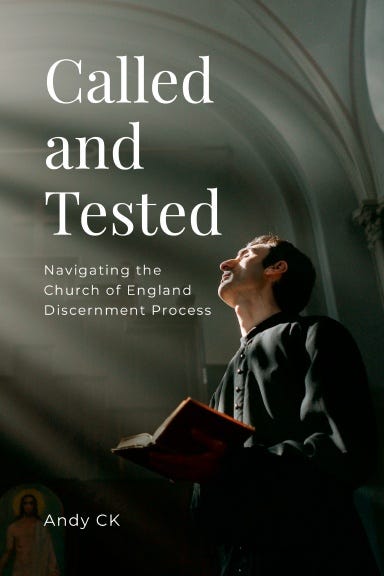
A Field Guide for the Messy Reality of Discernment
That is exactly why I wrote my new book, Called and Tested.
While the book uses the Church of England’s discernment machinery as its landscape, the survival tactics inside are entirely universal. Whether you are navigating an Anglican panel, a Methodist committee, or a Baptist ministry board, institutions are all fundamentally built the same way. They run on administration, they require you to jump through specific hoops, and they unintentionally tempt you to put on a mask to look like the “perfect” pastoral candidate.
I wrote this book because the Church does not need more plastic, uniform leaders. It desperately needs your unique, deeply sensitive, and profoundly resilient mind.
Called and Tested is the exact field guide I wished I had at the start of my own journey. As someone who navigates the world with an ADHD and dyslexic profile, I know what it is like to hit the wall of executive dysfunction when faced with a 5,000-word reflection essay, or to feel the immense sensory drain of a 48-hour residential panel.
What You Will Find Inside
This is not a dense theological textbook. It is a practical, ground-level survival manual designed to be picked up, put down, and aggressively dog-eared. It provides you with the “corridor intelligence” you will not find in official church brochures.
Inside the book, we tackle:
Decoding the Criteria: How to translate the institutional benchmarks into plain language, so you know exactly what the assessors are looking for without second-guessing yourself.
Conquering the Paperwork Mountain: Practical, neurodivergent-friendly strategies to overcome executive paralysis when faced with daunting administrative forms.
Surviving the Assessment Panels: How to build a robust strategy for navigating rapid-fire interviews and exhausting residential weekends without burning out from constant masking.
Protecting Your Basecamp: Crucial advice on setting firm boundaries to manage the emotional toll on your spouse and family, ensuring your household survives the process intact.
Navigating the Parallel Tracks: Dismantling the panic around the unexpected detours of special psychological assessments, occupational health checks, and institutional red tape.
You Are Enough
The single biggest lie of the discernment process is that you must be a flawless theological scholar with a perfectly ordered life to be chosen.
You do not need to be perfect. You just need a reliable map.
If you are exploring a call to ministry, or if you are already lost in the thick of the paperwork and the panels, this book is for you. It is time to drop the mask, take a breath, and navigate the path ahead with your authentic identity entirely intact.