


Writing a sermon, crafting an essay, or just sitting down with a dense theological text can feel like climbing Mount Everest when your brain is neurodivergent. The task isn’t just “read the book”—it’s a massive, amorphous, and overwhelming blob that often leads to total paralysis.
If you’re like me, you probably have ended up rushing your sermon at 11 PM on a Saturday night or staring blankly at a bibliography. Here are my three most essential strategies for moving from panic to production.
Three Essential Strategies for Conquering the Ordinand Study Reading List
1. The “Start, Not the End” Mindset
My ADHD brain loves to skip ahead. When I start reading Scripture or a text, my mind is already sprinting toward the finish line, arranging the points, crafting the clever hook, and writing the conclusion I’ve already dreamed up for the sermon or essay.
The issue is that this process creates my own narrative, which is a dangerous place to be when studying God’s Word.
Key Tip: When I approach any text, I consciously remind myself that I am at the START of something, not the end.
i.e. I am starting here so that I can understand more and do better, not so I can validate an idea I already have.
This mental shift is critical because it moves me away from thoughts of how a piece of scripture may fit my own predetermined narrative, and toward the text’s true, intended one. It stops the rush and creates space for true reading.
2. The Task-Clumping Strategy
Writing an essay is not just writing an essay. It typically involves: reading materials, finding sources, creating an argument, editing, and citing. These are all separate tasks that ask our brains to do very different things. Instead of switching back and forth (which is exhausting for a neurodivergent brain), I use Task Clumping to group similar tasks together.
For any major reading task, I break it down into four distinct stages:
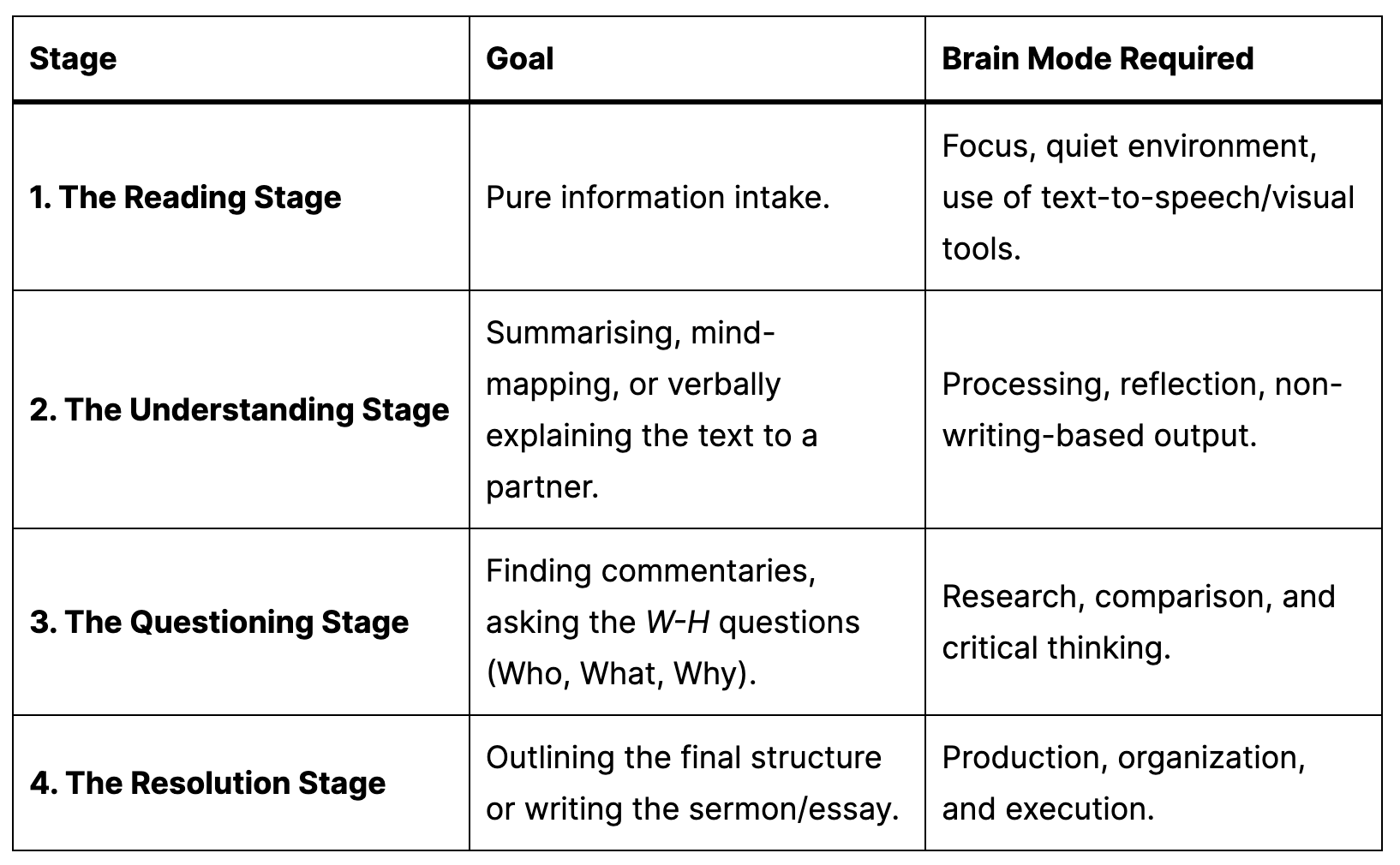
With ADHD, it is hard not to conflate these into one big, overwhelming task—a task so enormous that it leads to paralysis. By completing all of Stage 1 before moving to Stage 2, you give your brain a clean switch, reduce context switching, and build momentum.
3. Using Visual Aids to Anchor the Text
When approaching deep textual study, especially of the Bible, it helps to ground yourself in the process of reading. This is why I found the resource from The Bible Nerds so invaluable, as it emphasises structure and context—things our brains struggle to maintain.
I highly recommend watching this short guide (by Bible Nerd Ministries) to improve your method:

Managing the Shame of “Different” Tools
All of these strategies require using a different process than the “standard” neurotypical peer might use. Using specialised fonts (eg the Bionic Reading font), listening to text-to-speech, needing extended time, or simply getting up and pacing while you process information can feel like a confession of a flaw.
The truth is, there is no shame in using the right tool for the job God has given you.
If printing a service sheet on green paper (as I have done) it helps you worship and lead, then that is an act of stewardship over the gifts and limitations God has given you. The entire discernment process is designed to find out who you are, not how well you can imitate a neurotypical candidate. Be honest about your process, and let your work speak for itself.